

 By
By Samuel Emaha Tsegai*
Editor’s Note: The following review reflects the views of the author and does not necessarily represent the opinion of PEN Eritrea. Readers with different perspectives are welcome to join the conversation.
“They would Love to see me dead, so they can say: He belongs to us, he is ours.”
Mahmoud Darwish
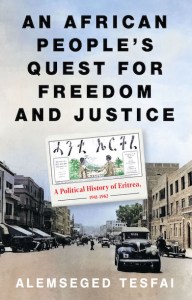
I long hesitated to write this review of reviews of Alemseged Tesfai’s magisterial book, An African People’s Quest for Freedom and Justice, because I had a plan to write a serious review of the book for a journal – something a monumental work of this magnitude richly deserves. While I still intend to write the review, I think engaging with public discussions and critiques of the book is also worth doing, more so when the critiques are lazy misrepresentations of Alemseged’s work and his character which obscure a proper appraisal of his seminal historical works and the Sisyphean labour he has exerted over the years in researching and writing them.
Woldeyesus Ammar opened the floodgate of disparaging Alemseged Tesfai’s work and character based on a reading of a mere five-page epilogue to a colossal 536-page book, even though he raised some valid questions and concerns. Following Ammar, Dawit Mesfin published on Martin Plaut’s blog what can only be described as a mean-spirited rant targeting not only the “epilogue” but Alemseged’s entire historical oeuvre and his character. Dawit followed up his initial post with another more melodramatic piece that exhibits, to put it charitably, an absurd understanding of a historian’s craft and an alarming lack of comprehension of plainly written text. My response will be limited to Dawit Mesfin’s posts.
Dawit Mesfin’s Charge Sheet against Alemseged
Even though Dawit Mesfin claims that he does not have any major issue with Alemseged’s body of work and the main content of his latest book, An African People’s Quest for Freedom and Justice, he nonetheless describes him as someone engaging in researching and documenting Eritrean history “often in a selective and convenient manner,” implying Alemseged’s fault is not limited to what he says in the epilogue but expands throughout his entire work. Dawit does not care to illustrate or support this serious charge.
Dawit praises Alemseged’s historical corpus as important but charges him of cowardice and “fear” for choosing to research and write about particular period of Eritrean history. He argues that Alemseged “sidesteps” the history of the Eritrean armed struggle and post-independence period and concentrates on Eritrean history between 1941 to 1962, because the latter is a historical subject “deemed safer to address.” Dawit is outraged by Alemseged’s failure to bridge the gap between the period that his four books cover and the period between the 1962 to the present. He also tells us that part of his disappointment is that he once had hoped Alemseged, like Edward Gibbon, an English historian who wrote the famous the Rise and Fall of the Roman Empire, would “one day deliver us from PFDJ’s tyranny.” I am a student of history, and I was never taught that one of the stellar accomplishments of Edward Gibbon, a politically conservative historian who opposed every movement for universal rights and equality during his lifetime, including the French and American revolution, was delivering his people from tyranny.
For any serious student of Eritrean history, the period between 1941 and 1962 is neither safe nor unimportant. It is a consequential period that continues to shape our present collective lives. Historical research about it is as relevant as it is urgent. Even if it did not have noticeable connections and relevant to our present condition, it is such a ridiculous thing to demand a historian writes about a particular period or theme, not another. Every historian has their period and subject that they want to investigate. Some are antiquarians, some are medievalist, and some are modernist. Some study the rise and fall of empires and states, and others study the history of sexuality, or a history of mosquitoes (a real bestselling book). They probe a subject which might or might not have political import for the present. For example, Dawit himself wrote a biography of Woldeab Woldemariam. No one accuses or should accuse Dawit for not writing about equally legendary figures such as Ibrahim Sultan or Abdelkadir Kebire or Ras Tessema Asmerom. He writes what he fancies, and we only evaluate how well he does what he does- I, for one, think his book is more of a hagiography written in the form of Gadle-Tsadkanat, without a single critical line about its subject, than a proper biography, but that is a subject for another day.
Dawit also takes issues with is the title of Alemseged’s book. He calls the title “misleading” because it had “quest” in it. He suggested the title should have indicated how that “quest for freedom and justice was thwarted” by the PFDJ government. He badly wants Alemseged to wade himself into current political discourse when the historical period he researches and writes is not about contemporary Eritrea. It is absurd to demand a book about 1940s and 1950s Eritrea bear a title that reflects the current condition in Eritrea.
Three further points about Dawit’s rage at Alemseged for not writing about the history of the Eritrean armed struggle and the present condition in Eritrea:
First, Alemseged is definitely a prolific writer and one of the few impressively productive Eritrean thinkers and writers. However, he is a human, not some kind of an Egyptian Thoth capable of authoring every conceivable work on every conceivable subject of any conceivable period. Alemseged has already done more than his lion’s share, and he cannot be faulted for not carrying the entire burden of researching and writing Eritrean history.
Second, even though Dawit thinks the only period/subject on which “genuine historians” should invest their intellectual energy is the current situation in Eritrea, it is probably apt to remind him that the present is not the province of historians. There are legions of writers who concern themselves with the present. Historians have a different calling.
Third, to demand from the safety and comfort of your adopted Western country that an octogenarian historian commit an intellectual kamikaze by writing about the present reality in Eritrea from inside Eritrea, “rise up on behalf of Eritreans,” and “face the punishment” is perverse and cruel. As a someone who self-identifies as a human rights advocate, Dawit surely knows what the punishments would be.
The main source of Dawit’s manufactured ire is the epilogue to An African People’s Quest for Freedom and Justice. In the epilogue, Dawit charges that Alemseged “boastfully claims that driving tens of thousands of ELF fighters off Eritrean battlefields was what shaped the EPLF’s nationalist principles”; blames the current predicament in Eritrea on the Eritrean Liberation Front (ELF); attributes the division within the Eritrean diaspora opposition to the historical rivalries between ELF and EPLF; dismisses the critical discourse on the current reality in Eritrea as a mere “disparagement of Eritrea”; offers a “flimsy excuses for the current situation in Eritrea”; and praises the PFDJ for its “iron discipline enforced by an egalitarian culture and air-tight secrecy.”
I re-read the epilogue several times and it does not say any of these at all. It neither boasts about the tragic ouster of the ELF from the Eritrean field nor blames it or its current reincarnations for Eritrea’s past and present problems. The epilogue is not an apologia for the PFDJ and does not dismiss the struggle and critical discourse against it as a reflection of the old ELF and EPLF feud and a “mere disparagement of Eritrea.” It does not commend the regime “for its policies of creating an atmosphere of congeniality and camaraderie among EPLF fighters, for promoting gender equality, for enforcing equality in religion and language and for fostering uniformity and conformity within it.” It only cursorily mentions historical ELF and EPLF not their current reincarnations. It barely says anything about the PFDJ or the current situation in Eritrea, let alone dismiss or obscure the harsh realities in Eritrea that Alemseged has direct and deeper understanding of than his critics.
One of the most bizarre things Dawit tries to do in his tirades is to paint Alemseged as an indifferent and opportunistic “Isaias apologist” who chose to write history while some of his erstwhile comrades – such as Haile Weldetnsae, Petros Solomon, Mahmud Sherifo, whom Dawit calls Alemseged’s mentors, even though he is older and more educated than most of them and has similar revolutionary credentials – confronted Isaias Afewerki’s rule and paid the ultimate price for it. Under the pretext of putting the publications of Alemseged’s scholarly works in “context,” Dawit chronicles the events of government crackdown against dissidents and private media, the country’s international isolation and mass exodus of young Eritreans, thereby insinuating that Alemseged has been either complicit or indifferent to these catastrophic experiences. This serious charge would have been acceptable if Alemseged’s scholarly works were concerned with post-independence Eritrea and failed to address these events. However, to accuse a historian of 1940s/1950s Eritrea of indifference, betrayal, opportunism, and lack of ethical and intellectual integrity and courage because he has not written about contemporary Eritrea, is unbelievably malicious sleight of hand against a fellow writer who admirably continue to work and live in Eritrea.
In passing, while Dawit assumes superior intellectual and ethical authority, it is relevant to point at the numerous factual errors he commits:
- In his brief biographical note, he writes that Alemseged received his master’s degree in landscaping from the University of Illinois in 1971. Alemseged earned LLM (Master of Laws) in 1972 and was a doctoral candidate in Law at the University of Wisconsin, Madison. I do not know what the definition of a “college dropout” is in the United Kingdom but Alemseged quitted his PhD candidacy in law and a promising future in 1974 to selflessly dedicate his life for a greater collective cause – a principled ethical and revolutionary decision that not everyone can commit.
- Dawit claims that after joining the Eritrean People’s Liberation Forces, Alemseged started serving under Haile Woldetnsae (Duru’e) in the “National Leadership Department.” First, Alemseged was part of the department of education and that department was headed by Beraki Gebreslasie. Haile was heading the Political Department of the Front in 1970s. Second, there was no such a thing as the “National Leadership Department” in the EPLF. Dawit Probably meant The Department of National Political Guidance? In the 1980s, Alemseged became part of the Department of National Guidance head by both Haile and Alamin Mohamed Said.
- Eritrea’s Research and Documentation Center, where Alemseged works from and where I also used to work, is not under the Ministry of Information as Dawit claims.
- Dawit states that there “is a belief that many non-Tigrinya speakers should be able to access Alemseged’s books…in Tigre and Arabic.” Alemseged three volumes are translated and available in Tigre and Arabic.
- Mahmud Sherifo was officially neither a vice-president nor minister of interior. He was a minister of local government.
What the epilogue really says and does not say?
The main objective of the five-page epilogue is to outline, in very broad terms, what the author thinks is hamstringing historical research and writing about the Eritrean armed struggle for independence. It attempts to point at the archival, ideological, and political hurdles that prevent an objective and dispassionate examination of this important period in modern Eritrean history. To illustrate the problem, Alemseged notes how any discussion, written or unwritten, about the Eritrean struggle is marred by partisan polemics and is shot through with bitter political differences that goes back to the ELF-EPLF bloody rivalry during this period. Alemseged laments the fact that official historical narratives, memories, and interpretations of this period produced by both revolutionary movements and their current incarnations, continue to shape current historical writings about this period.
Related to the political/ideological hurdle, Alemseged points at the difficulty a bona fide historian encounters with negotiating access to both organizational and individual archives- written or oral. The secretive nature of the EPLF and the tight grip it has on information, the top-down strict control over information and documentation, the refusal, reluctance or inability of the main figures of the liberation movements to write and reflect about their experiences or open themselves to serious historians mean that it is impossible to write a definitive history or histories of the Eritrean armed struggle. To be clear, some people in Eritrea and outside Eritrea do write about the history of this period. However, Alemseged correctly finds them wanting. Some of them are mere chronicles of battlefield events and some are regurgitations of the official historical narratives. Compounding the problems is the corrosive nature of social mediascape and how it erodes objectivity, truth and reality. Alemseged also notes how Eritrean history has been subjected to “disparagement” under non-Eritrean scholars and offers the works of Christopher Clapham and Alex De Waal as illustrative examples. As a serious independent historian with impeccable intellectual integrity, Alemseged rightfully does not want to engage in such historical work. Despite all these, Alemseged, does not argue for the suspension of historical research and writing on the armed struggle. He underscores how important and urgent it is for this period of our history to receive serious attention from historians – preferably a new crop of Eritrean historians who are relatively free of the shackles of the prevailing official narratives.
In the part of the epilogue, which cursorily discusses the ELF, Alemseged does not disparage the ELF at all. He is in fact very deferential and charitable. He describes the ELF’s pioneering initiative to start the armed struggle as “momentous” historical milestone that elevated the movement for independence “to its highest and final form.” In his other book, Eritrea: From Federation to Conquest and Revolution, 1956-1962, Alemseged has written in length on how the ELF has not received fair and sufficient historical attention commensurate with its with its historical stature and urged historians to initiate serious and thorough research about it. As a historian, he also offers a passing remark in his epilogue about what he thinks were the two main birth defects of the organization which created dissention among its file and ranks: lack of clearly articulated political program and effective and non-partisan organizational structure, something he also says about the Eritrean political organizations in 1940s. Within the general remit of the epilogue, i.e. pointing at challenges that historical research and writing on the Eritrean armed struggle faces, Alemseged does not spare the EPLF from his criticism as well. He notes how its secretive nature, very tight control on information, and its insistence on conformity to official lines make an objective historical work very difficult, if not impossible.
I admit a legitimate and good-faith debate could be had about this. But Alemseged’s two mildly critical lines about the ELF’s initial political and organizational defects are cogent. In their initial years, both the ELF and EPLF struggled to articulate their political program, refine their organizational structures and crystallize their political vision for liberated Eritrea. That was the reason why they went through various cycles of dissention and paralysis. Unlike typical leftist liberation movements of the 1960s, which generally tended to produce thick political manifestos and programmes that could kill a skinny-legged Eritrean, our liberation organizations were not known for their intellectual output until mid 1970s when they showed great progress in clarifying/articulating their political programmes, organizational structures and their visions for post-occupation Eritrea in 1970s through various publications.
An African People’s Quest for Freedom and Justice is a page-turner. It tells a complicated story of a people in quest of freedom and justice – an ongoing pursuit that awaits full triumph – through extensive consultation of rich written and oral local archives. Alemseged’s prose has always been delightful, and this book is not an exception. He deserves both the highest praise and serious scholarly engagement for his lifelong contribution to Eritrea’s literature and history, despite enormous challenges, including some personal.
_____________________________________________________________________________________
*Samuel Emaha Tsegai is a PhD candidate in history at Queen’s University, Canada.
